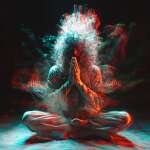


Different cultures have different interpretations of dragons, with differing roles, nature, and status in the world. In western cultures, dragons are more seen as monstrous or demonic beasts of great power that bring disasters wherever they go. In eastern cultures, specifically in Chinese culture, dragons are known as 龍 (Long) and are often treated as divine existences on the same level as gods and immortals.
According to Chinese legend, both Chinese primogenitors, the early Shennong and the Yellow Emperor (Huangdi), were closely related to ‘Long’ (Chinese dragon). At the end of his reign, the first legendary ruler, the Yellow Emperor, was said to have been immortalized into a dragon that resembled his emblem, and ascended to Heaven. The other legendary ruler, the Yan Emperor, was born by his mother’s telepathy with a mythical dragon. Since the Chinese consider the Yellow Emperor and the Yan Emperor as their ancestors, they sometimes refer to themselves as “the descendants of the dragon “.
Dragons (usually with five claws on each foot) were a symbol for the emperor in many Chinese dynasties. In the Yuan dynasty, the two-horned five-clawed dragon was designated for use by the Son of Heaven or Emperor only, while the four-clawed dragon was used by the princes and nobles.
As you might guessed by now, for this project, the Dragon in the title specifically refers to the Chinese Dragons, the Longs.
Chinese dragons are strongly associated with water and weather in popular religion. They are believed to be the rulers of moving bodies of water, such as waterfalls, rivers, or seas. The Dragon God is the dispenser of rain as well as the zoomorphic representation of the yang masculine power of generation. In this capacity as the rulers of water and weather, the dragon is more anthropomorphic in form, often depicted as a humanoid, dressed in a king’s costume, but with a dragon head wearing a king’s headdress.
While Chinese Dragons (Long) are a specific group of dragons in itself, it is further divided into sub species such as the Flood Dragon (Jiao long or simply Jiao) and the Torch Dragon (Zhulong) among many others. According to one source ( Ren Feng’s Shuyi Ji (Record of Strange Things)), a water snake (hui 虺) after 500 years transforms into a jiao (蛟); a jiao after a millennium into a dragon (long ), a long after 500 years a horned dragon (角龍), a horned dragon after a millennium into a yinglong (a winged dragon).
The project consists of 2 important elements:
1. 龙变 (Dragon Transformation)
2. 修仙 (Immortal Cultivation)
The Dragon Transformation and Immortal Cultivation dual elements complement each other whereby progress in each element speeds up and strengthens the foundation for the other element’s progress and effects, which are mutually multiplicative. The project also aims towards making the entire cultivation process one that is as natural as breathing, effortlessly so, over time and repeated use such that every breathe will draw Draconic Qi provided by the project as well as origin heaven and earth qi to nourish and build up the user’s cultivation.